Blog
Athleisure advertising research: 2,090 live Meta ads, and almost none older than a month

Atharva Padhye

On October 7, 2026, five of the biggest athleisure brands had 2,090 ads live on Meta in the US. 1,833 of them, 88%, had started in the previous 28 days. Fifty-one were more than 60 days old.
Those numbers come from a piece of advertising research we ran on five Ad Library pages: every live ad, dated, grouped and read.
Monday, 9 a.m. You open a competitor’s page in Meta Ad Library, the public page where Meta lists every ad a brand is running. You scroll to the ads that have run the longest, because an ad that old must be working, and you paste three into the creative brief. Most ad research starts this way.
At Gymshark, Alo Yoga, Lululemon, Athleta and YoungLA, that habit reads 0.4% of the account. Nine ads with a button on them, out of 2,090, were older than 60 days. The rest of the page shows how these brands work.
(Seven of the nine are Gymshark ads from July 2, all headlined “Shop Best Sellers.” They come back near the end.)
How this advertising research was done
Meta Ad Library lists an ad for as long as it runs. A brand’s page on any one day is a full record of what the brand has chosen to keep live. This is research on advertising from the outside, the same view your competitors have of you.
On October 7 we pulled every live US ad from the main page of each brand: 735 from Gymshark, 776 from Alo Yoga, 268 from Lululemon, 174 from Athleta and 137 from YoungLA. We dated every launch, grouped the ads that share a visual and read every headline and line of ad text. Each number below describes that one day.
Share of demand, share of ads
Semrush counts how often each brand name is searched in the US in a month. Lululemon is searched 7.5 million times. Alo Yoga, searched as “alo,” is at 1.5 million, Athleta and Gymshark are at 823,000 each and YoungLA is at 450,000. A brand’s slice of those searches is its share of demand.
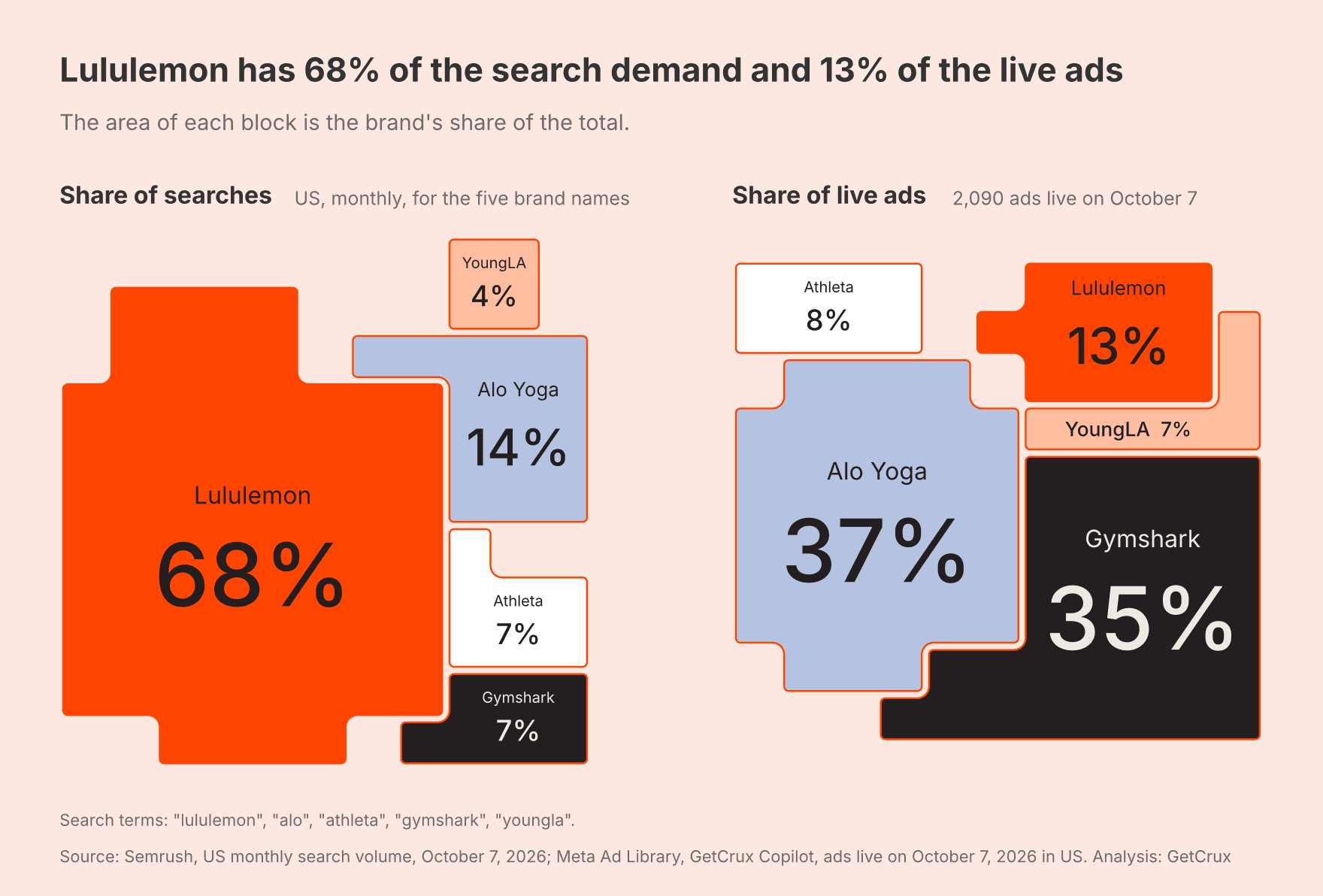
Lululemon holds 68% of the demand and 13% of the live ads. Gymshark and Alo Yoga hold 21% of the demand between them and 72% of the ads. Gymshark had 89 ads live for every 100,000 monthly searches of its name, and Lululemon had fewer than four.
The brand everyone already searches for runs the smallest library for its size. The two largest libraries belong to brands with a fraction of its demand. If you are the challenger in your category, Gymshark and Alo Yoga are the libraries to measure yours against.
Libraries arrive in drops
On one of our sales calls, a buyer described paid social, the ads you run on Meta and TikTok, as a matter of how fast you can make new creative and “keep fueling the system.” This is what fueling looks like from the outside.

Athleta had 174 ads live, and 159 of them started on October 6, the day before we pulled the data. Thirteen of those carry the headline “The Fleece Shop.”
Gymshark’s library came mostly from three days: 151 ads on September 30, 339 on October 1 and 122 on October 5. Of the 122, 119 point to one page for a collection called Adapt Solid. Lululemon started 141 of its 268 on October 2. Alo Yoga and YoungLA spread their launches over more days, and their oldest live ads were still only 54 and 50 days old.
A note on wording: a start date belongs to an ad, and a brand can relaunch an old video as a new ad. So the word here is “started.”
The batches follow the product calendar. Athleta’s batch sells fall fleece and outerwear, and Gymshark’s October 5 batch sells Adapt Solid. If you run growth at an app, your version of a collection is a feature release or a new market.
Gymshark runs 735 ads and says 84 things
“It looks diverse, but it’s not,” a buyer told us about their own Ad Library page: plenty of ads, and two themes underneath them. Five much larger advertisers have the same shape.
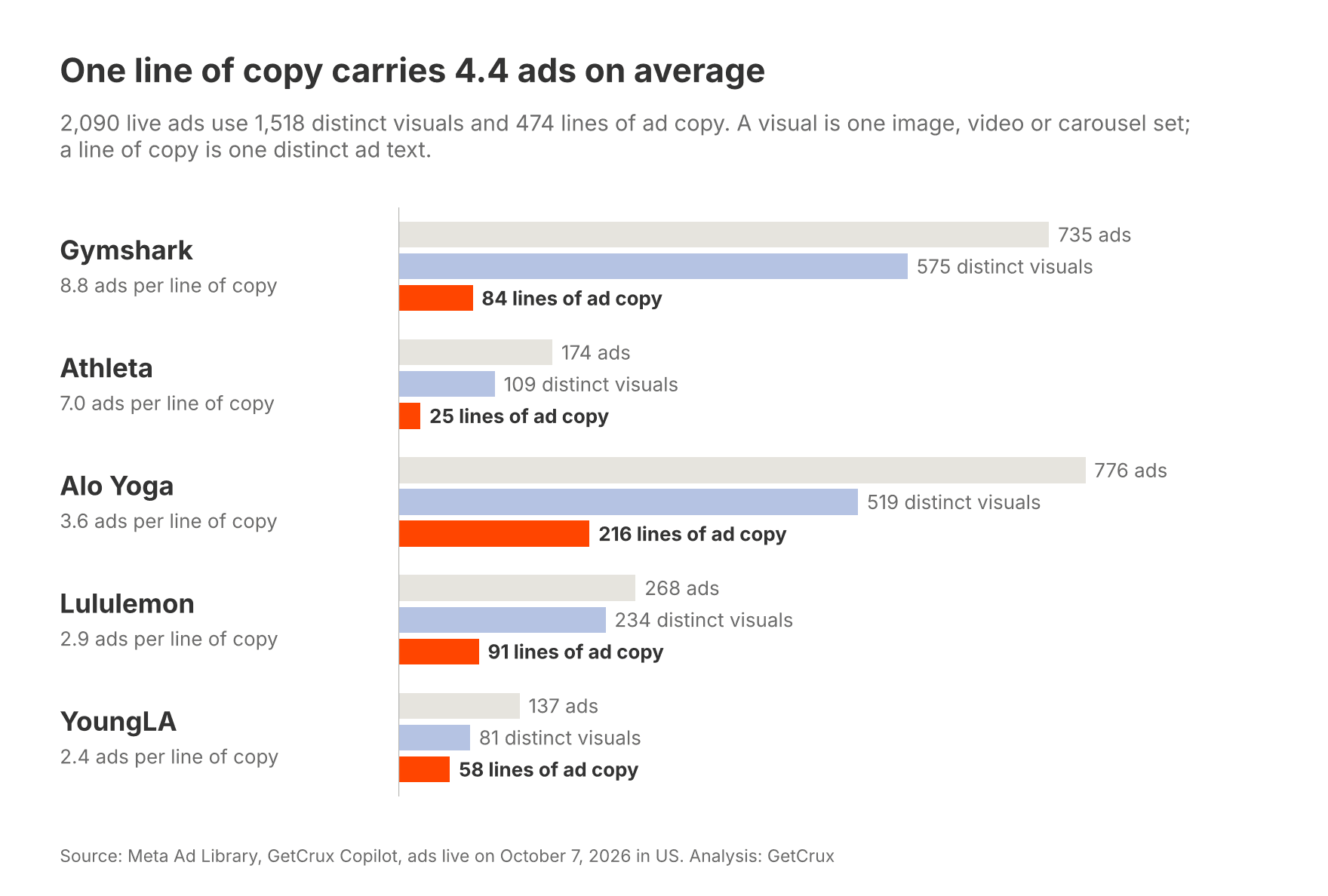
The 2,090 ads use 1,518 distinct visuals and 474 distinct lines of ad copy. Gymshark is at the far end with 735 ads, 575 visuals and 84 lines. One sentence, “Show up and keep making progress in kit that everyone loves,” runs on 48 of its ads.
You have probably counted your own live ads this quarter. Gymshark’s count is 735, and it says 84 things.
Another buyer told us they turn away vendors who offer “500 versions” of their best ad, because the platform needs variety to work with. These libraries show which kind of variety large advertisers pay for. The message is the constant and the picture is the variable: Gymshark makes 84 points with 575 different pictures. To these brands a new picture is a new ad, and a new message is a much rarer event.
Five brands, five format mixes
Buyers tell us they study competitor ads before they brief their own. One said their team gets “a lot of inspiration” that way, and that it works. Which competitor you study decides what you bring back.
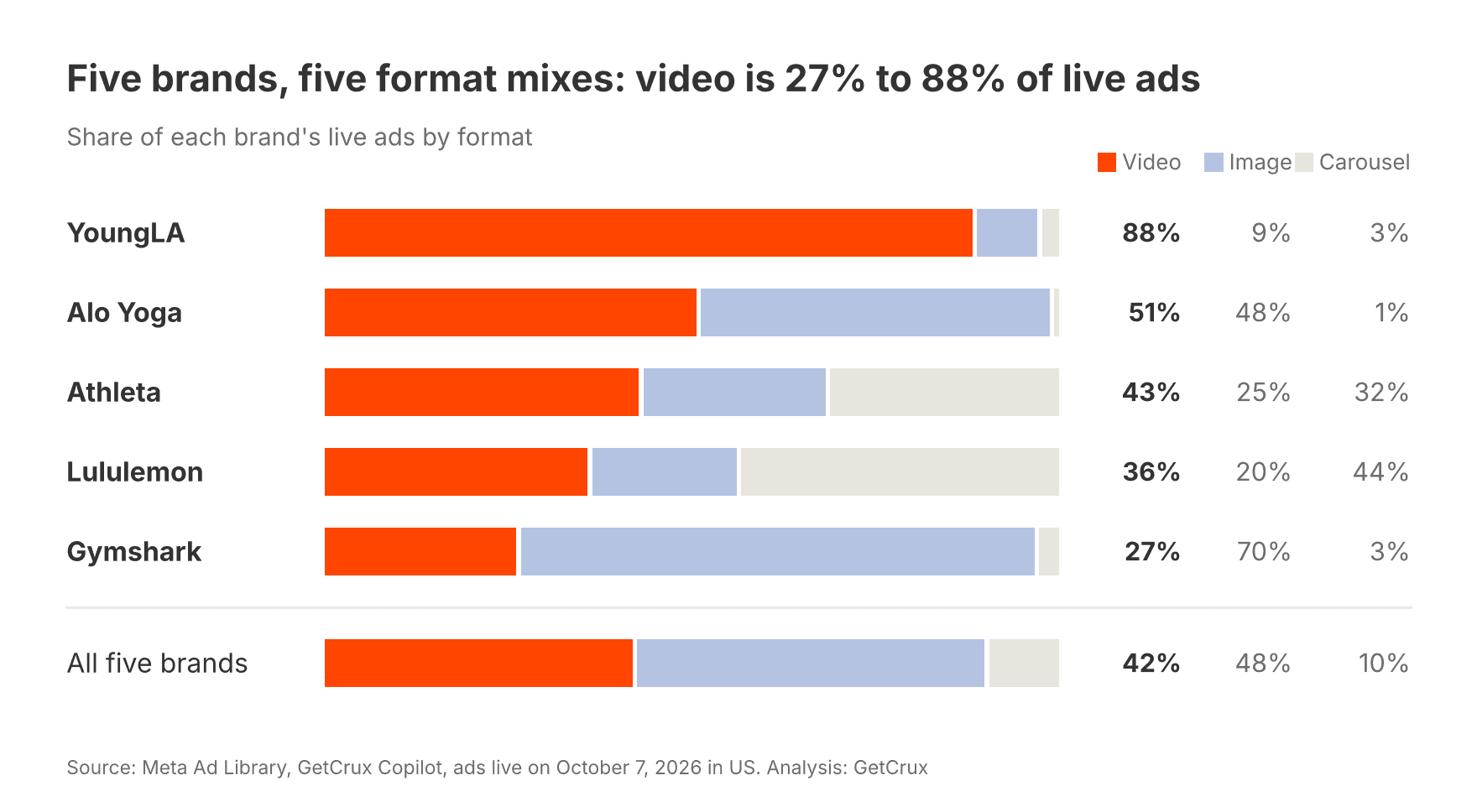
YoungLA’s library was 88% video. Gymshark’s was 70% still images and 27% video. Lululemon was the only one built on carousels, ads with several cards you swipe through, at 44% of its library. Many of those carousels use a product name as the headline, such as “EasyFive Slim-Straight Pant 34L.” Lululemon can sell by product name because people already search it that way: Semrush puts “lululemon backpack” and “lululemon bag” at 135,000 US searches a month each.
All five were selling gym clothes on the same platform in the same week. A format rule copied from one of them is that brand’s choice, and the other four each made a different one. (If you have never copied a format rule, skip to the next chart.)
New is the offer
A hook is the reason an ad gives you to stop scrolling. In 899 of the 2,090 ads, 43%, the hook in the headline or the ad text is that something is new: a drop or a restock. 26% lean on best sellers and favorites. 18% carry a named person or a collaboration. Alo Yoga puts the name in the headline, and “Bella in ALO,” “Kylie in ALO,” “Joe Burrow in ALO” and “JISOO in ALO” cover 94 of its ads.
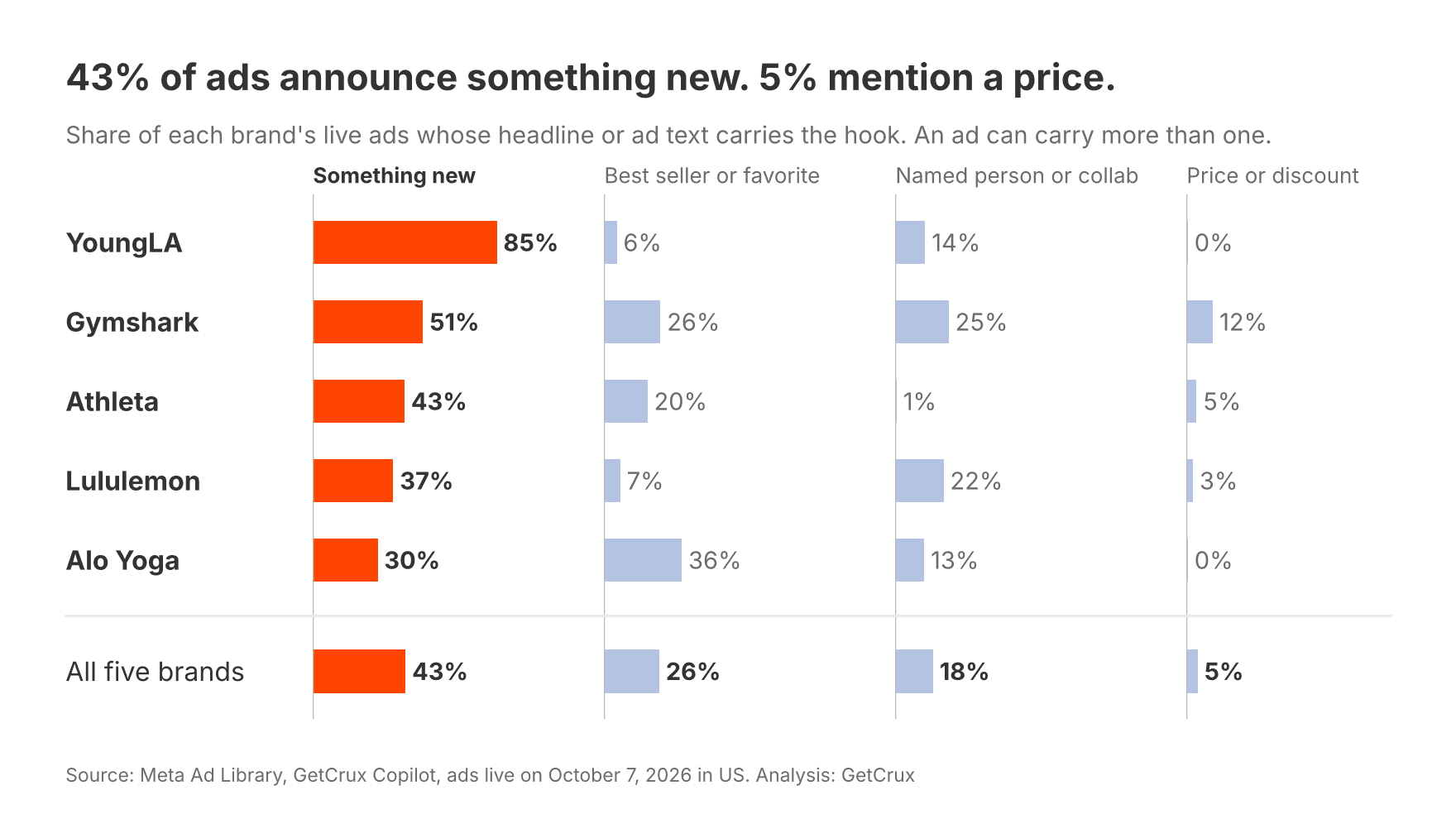
Price appears in 106 ads, 5% of the total, and in 90 of those Gymshark quotes a starting price such as “from $24.” Alo Yoga and YoungLA mention no price in any ad. Seven weeks before Black Friday, the pitch at these five brands was newness, and 95% of their ads never mentioned a price. The demand for a deal shows up in search. Semrush counts 22,200 US searches a month for “gymshark discount code” and 6,600 for “youngla discount code,” and YoungLA’s ads answer with no price at all.
The seven ads that stayed
Back to the seven Gymshark ads from July 2. They are still images under the headline “Shop Best Sellers,” and they are the oldest ads with a button on Gymshark’s page by almost eleven weeks. Meta’s Ad Library can order a brand’s ads by impressions. In that order, four of the seven were first, second, third and fourth out of 735.
That is the second layer of the account. The first layer is hundreds of ads that announce what is new, most of them under four weeks old. The second is a handful of ads that sell the best sellers, and Gymshark has kept them live for 97 days. A brief built only from a competitor’s oldest ads copies the second layer and misses the first.
How to read a competitor’s ad library
A competitor’s library reads best in a fixed order, and the first step is outside the library.
Demand comes first. Share of search tells you what kind of advertiser you are reading before you open a single ad. A brand with 68% of the searches and a brand with 7% are solving different problems.
Launch days come second. The dates show the calendar a brand runs on, and the size of a batch shows how much creative it makes for one product moment. Gymshark had 133 ads live for Adapt Solid, a collection that, by the ads’ own copy, would drop the next morning.
Messages come third. A page with 735 ads can be making 84 points, and the count of points tells you how many ideas you are up against.
The ads that stayed come last. They are few, and they show what a brand treats as evergreen.
Buyers ask us for “the why of a creative performing.” A competitor’s library gives you half of that answer, and your own account’s results give you the other half. We pulled, grouped and read all 2,090 of these ads with GetCrux Copilot in an afternoon.
Open your own page in Meta Ad Library and count the live ads that started more than 28 days ago, or ask GetCrux Copilot to count them for you.
Find the crux,
Atharva
P.S. Athleta’s oldest live ad that day was seven days old :)