Case Study
Who an end-to-end ad creative operating system is not for: a mock sales call with our co-founder

Sayan Das

“If you need 10 creatives a month, you shouldn't be working with a tool like GetCrux.”
Atharva Padhye, our co-founder, said that to a founder near the end of a sales call. The founder was me.
I run growth at GetCrux, and for this conversation I played the founder of Mint Path, a personal finance app that doesn't exist. Mint Path spends $300K to $400K a year on Meta and TikTok. Its ad creative comes from an agency, and one person runs a scrappy Claude pipeline on the side. Atharva answered as he would on a real call.
You've probably run some version of that setup yourself. I asked what I'd want to know before working with anyone: when an in-house setup is enough, and why we shouldn't build the rest ourselves.
(If you only want the numbers, skip to “Who GetCrux is for.”)
The conversation is edited for length. Each graphic marks a point you can check against your own ad account.
The setup: $300K a year, one agency, one Claude engineer
Sayan: Thanks for joining, Atharva. I founded Mint Path, a personal finance app. We help young people set aside money from their day-to-day spending, and that money is invested in stocks automatically. It runs on a subscription. You set money aside, and the app allocates your savings to the model that suits you, based on your preferences.
We raised some money recently, and most of our customers are in the US.
We run ads, about $300K to $400K a year, mostly on Meta, with some TikTok. The metric I track is what it costs us to get a trial: someone downloads the app and starts a trial. After that, I look at conversion rate.
My team has a head of growth and someone who handles performance marketing. Our creatives come from an agency we've worked with for a while. That's the setup.
I've seen friction in how this works today, mostly around time to go live, and I've had some challenges with the team on it. I have my own opinions, but this is a fireside chat, so let's talk it through. What's worth looking into, and are we moving at startup speed?
First, though, I'd love to hear about you. What does GetCrux do?
Why GetCrux started
Atharva: I'm one of the co-founders of GetCrux. We started the company four years ago, when we were building a consumer app ourselves, in gaming and entertainment. We used Meta to acquire our first users, and that meant working with a lot of agencies. Doing user acquisition that way, we ran into problems that led us to start GetCrux in its current form.
Four years ago, Meta was in a transition. It was moving from being targeting-led and campaign-led to being creative-led.
Sayan: Interesting. What was the moment that made you decide this needed a bigger effort to solve?
Atharva: Meta started telling advertisers that creative was going to be the main lever for performance, and the whole industry pushed to produce more creatives. Our setup was the same as yours. An agency supplied our creatives, and we ran into two problems.
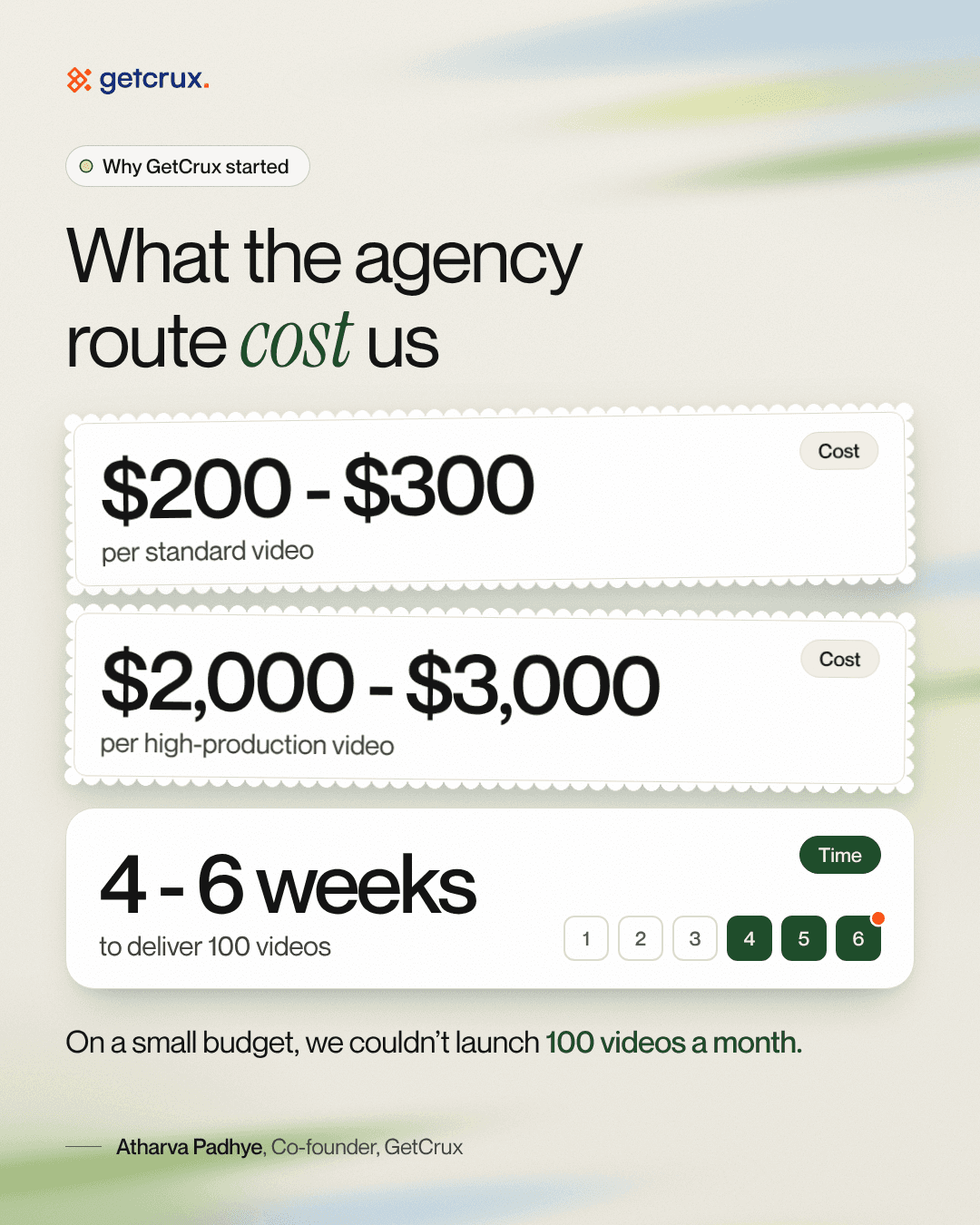
The first was cost. Every video cost at least $200 to $300, and the high-production ones were $2,000 to $3,000 each. On our small budget, we couldn't launch 100 videos a month.
The second was time. When we asked for 100 videos, they took at least four to six weeks to deliver. So we were never able to scale Meta 2x or 3x within a few months. That was the main challenge.
When a scrappy in-house ad creative setup is enough
Sayan: The cost of creatives is something I'm facing too. Right now I've given my team the standard generative AI subscriptions. My growth team, which is one person, has become a Claude engineer of sorts. He's built his own pipeline. It's scrappy, but it does the job.
From your conversations with clients, at what scale is a scrappy setup like this good enough, and at what point do we need a proper framework around the whole process? Right now we get the job done. My main issue is time to go live, which I'll come to. But what do you think of this stack? I'm sure plenty of teams are using it.
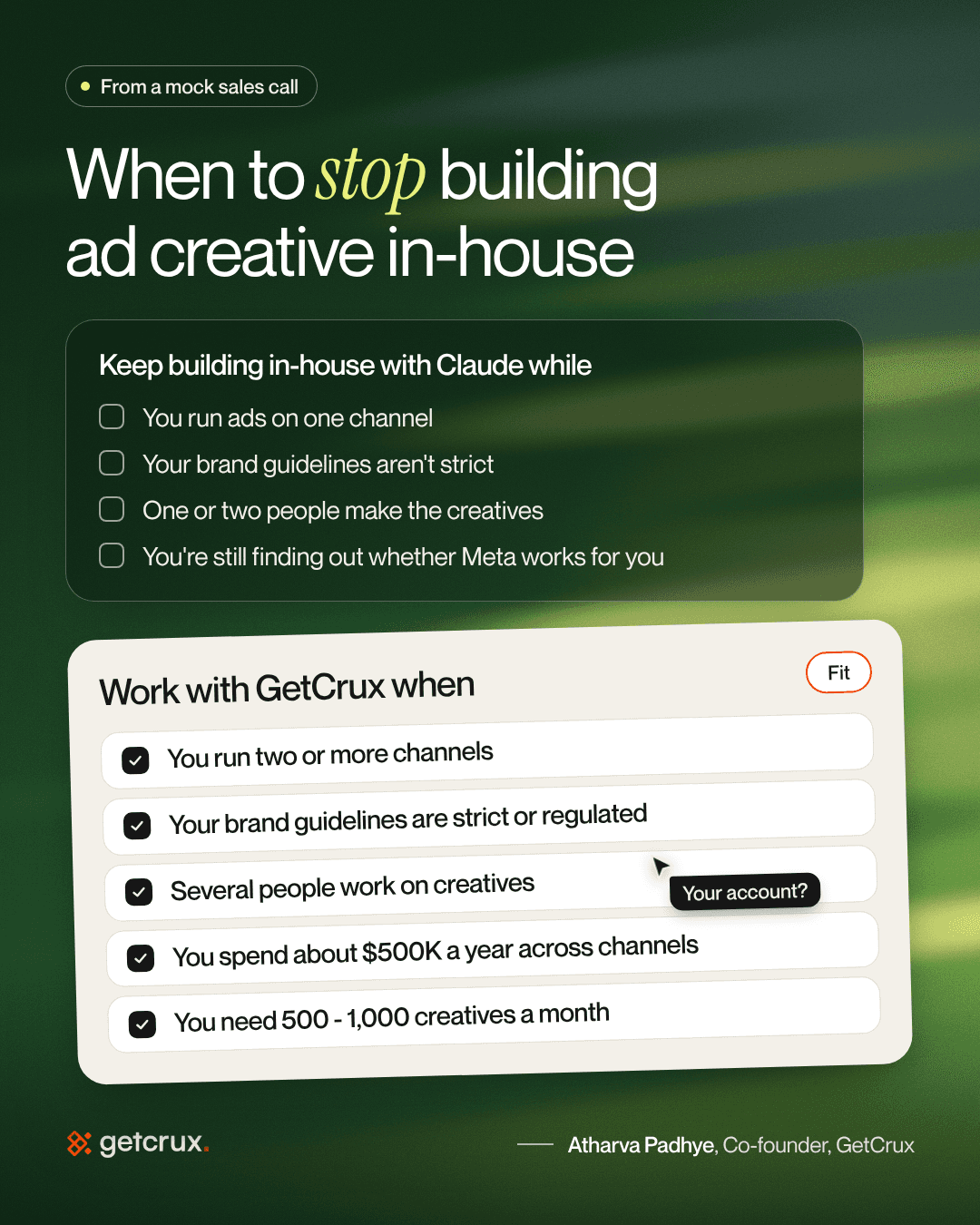
Atharva: I think it's the right stack until you hit the complexity of scale. To put it more precisely: as long as you advertise on one channel, say Meta, you don't have strict brand guidelines, and you don't have several team members working on this, it's absolutely fine.
With a couple of people and Meta as your only channel, you should use Claude and build your own workflows. At that point you're still figuring out whether Meta works for you. You don't even know if it'll be your number one channel. So keep the in-house setup with Claude automation workflows.
Where we've seen things break is when you extend to more channels. Now you're producing creatives for two channels that need two different kinds of creative.
The tools these creatives come from, like Nano Banana, Higgsfield, Runway or HeyGen, are built for creators, freelancers and individual businesses. They aren't built for enterprises or large teams with strict brand guidelines. That's where internal automation workflows break.
A regulated brand and AI creatives
Sayan: We're in a domain like that. We're in finance, and there's regulation on how we can run our business. In the past, some of our creatives were flagged and we couldn't push them out, even though the brief to the agency was clear. So there's back and forth. When that happens, the agency is considerate enough to redo the work, since our brand guidelines are already in place. The cost is time.
That brings me to AI creatives. My view is that AI creatives erode brand trust to some extent. You may say I'm not the perfect customer for you, but what have you seen with customers who make AI creatives work?
Atharva: I think of creative production and advertising in two phases: testing and scaling.
In the testing phase, you're answering a few questions. Who is my persona? What do they care about? What can I solve for them? As a consumer app founder you have a rough idea of the answers, but the market is enormous, so you have to keep discovering them. The answers also change over time.
AI creatives fit the testing phase well. You're not spending millions of dollars on them, you're spending a couple of thousand. Their impressions aren't in the billions. They're in the thousands, maybe a million. So most of your audience never sees them, and they're a cost-effective way to find the answers.
So AI creatives are the base, about 90% of your creative volume. The other 10% is authentic, human-led, founder-led content, and that's what you scale once you have the answers.

Build vs buy for a head of growth
Sayan: Fair enough, that's a valid argument. Back to the testing phase. My team has often said that once we leave testing and move into scaling, we'll have the resources and the stack to build something like this in-house. The build versus buy debate always comes up in our industry. What sets you apart, and why can't my head of growth do this himself?
Atharva: Resources are limited, for a startup or a large organization, so you have to be ruthless about what you optimize for. If your head of growth is deciding how to spend 100% of their time, I'd want 90% of it going to customers, research and the next growth strategy. I wouldn't want them bogged down in technical issues.
When you build something like this in-house, issues come up day in and day out. We have a large engineering team, and we see it. AI is great, but it runs on data systems that are still very messy. Take Meta. Meta ads have been around for nearly 20 years, and they still haven't built robust API documentation.
Every other week we hit API documentation issues that nobody has answers to. I can't imagine your head of growth would be excited to read API documentation or talk to Meta support. Talking to Meta support is the worst punishment you could give a team member.
Sayan: I love that. And it's fair. It's something I've been thinking about lately: can someone else take care of the tech stack? It isn't our core competency. We want to understand what works for our customers, and we want to build features that give them a smooth experience in the app.
A lot of our customers are Gen Z, because that's where we see traction, and they've been more receptive to AI creatives than people like us. Memes do really well for us, and that's something I personally want to scale. I'm not sure the agency route is right for it. Something like that might be a prompt away. So I see a gap there, and kudos to you for going after it.
Who GetCrux is for
Sayan: But I don't want to trust a team like GetCrux blindly. Which logos are behind you, and what proof do you have from recent work?
Atharva: We work with a broad portfolio, from fast-growing consumer apps to the Fortune 1000. You'd be a strong fit if you want to truly scale your creative engine.
Our customers include some of the fastest-growing consumer apps, like Rocket Money, Noom, Ethos and SoFi, and younger ones like Cloaked, which reached a billion-dollar valuation in a couple of years and has raised $375 million with a two-person marketing team. Teams like that, ambitious and aiming to grow 10x over the next couple of years, are our best fits.
Sayan: How do you qualify a lead as ready to scale? There's intent, and then there are numbers. On numbers, what's your ideal customer profile?
Atharva: Anyone spending at least about $500,000 a year across all channels is a good starting point. At that level of spend, the ad account has enough data to show what's working. That spend also implies a decent creative volume. If you need 10 creatives a month, you shouldn't be working with a tool like GetCrux. If you need 500 to 1,000 creatives a month, that's when the real ROI shows up.
Sayan: I think our startup is at the borderline of your criteria. And that makes sense. We've made conscious decisions about who we're for and who we're not for, too. So any brand with that level of ad spend, across all channels, should look at GetCrux.
Atharva: Yes.
How an engagement starts
Sayan: This is probably the right solution for us. What does the process look like? Say we start with a demo. What's the workflow, and when could we begin?
Atharva: We have two operating models. The first is a self-serve platform that gives your internal creative team more control over the workflows they build. Our team supports you, but it's largely self-serve, and you own the outcome.
The second is managed services. Our creative strategists work on your account, go deeper into what is and isn't working, and deliver creatives as the final outcome.
Both start with a creative strategy audit. Once you connect your ad account to GetCrux, we look at what has already happened in it, which angles and formats have worked, and that sets a creative testing plan for the next eight weeks.
We recommend following the plan for at least eight weeks before expecting a lift in performance. AI isn't a one-shot solution where you follow the recommendations and performance improves. It has to be iterative.
Sayan: Got it. So if I want to start quickly, I book a demo, and eight weeks is when we can expect results?
Atharva: Yes. Some accounts improved sooner, and some took three months. Eight weeks is our recommendation.

Sayan: Good to hear. That's it for our call. Thanks for joining, Atharva. We'll speak soon.
Atharva: All right, awesome.
Check your ad account against the checklist
Check your ad account against the five conditions in the first graphic, and if it meets most of them, book a demo. You can also read our GetCrux case studies with real customers.
Find the crux,
Sayan
P.S. Atharva had no brief before this call.