Case Study
How Jerry's growth team replaced days of ad analysis with one question

Atharva Padhye

Impact at a glance:

About Jerry:
Jerry is an app-based car insurance assistant. Users can compare quotes from 50+ carriers, customize a policy, buy it and get their insurance card without leaving the app. Other features include Drive Shield, which tracks driving to unlock discounts, and Garage Guard for car maintenance.
The company has grown to between 150 and 250 employees. Most rivals in car insurance still operate online as middlemen on Google, while Jerry handles the whole journey inside its app.
About GetCrux:
GetCrux is an AI creative intelligence platform for paid social. Growth and creative teams connect their Meta ad account, ask questions about their creative performance and turn the answers into new on-brand ads.
Meet Myles Murray
Myles Murray is an Associate Creative Producer on Jerry's growth team. Jerry is his first job out of college. He started on the social media side of the communications team, then moved to growth to work on paid ads, where he has stayed for a little over four years.
"As someone who works in ads, your goal is to make highly effective ads that convert the right customer and make the company money. That is something I found I like more than I thought I would."
We spoke with Myles about how Jerry builds ad campaigns in a hard category, where AI tools still fall short, and how GetCrux changed the way his team learns from its ads.
1. Know your customer to a T
Car insurance is a product people buy because they have to. Myles calls it a "not pretty" industry, and he believes that makes customer knowledge the deciding factor in every ad.
"You are selling something people do not want to do. So you really have to know every single pain point your customer goes through in that process, and where your product helps with each one specifically."
Jerry invests heavily in user interviews. The team speaks with people who have used the product and with people who have not. Real problems from those conversations are then written into video scripts and static ads, so the viewer sees an ad that says, in effect, "we know this is your problem".
2. Every ad has a primary angle and a secondary angle
Research also sets the structure of each creative. Before production starts, every Jerry ad is assigned two messaging angles.

The primary angle is the main reason the product adds value for that customer. The secondary angle is a supporting benefit, important but less central. Fixing both before production gives every test a clear hypothesis, which makes the results easier to read later.
3. Red, yellow and green: how Jerry sorts every ad
After an ad has run, the team places it in one of three buckets. The method was first used at scale by another DTC brand, and Jerry adopted it for its own Meta ads.

Red: the ad underperformed. It is left alone.
Yellow: the ad shows potential and holds useful learnings. The team checks what worked in its green ads and applies those elements to move a yellow ad up.
Green: a top performer that is scaled and sent back into the pipeline for iteration.
Myles stresses that red ads are part of the job.
"Reds are not bad by any means, because you do have to take large creative swings. A lot of the best campaigns you have seen were crazy ideas that could very easily have been a red in another industry."
Balance matters as well. If a team only reworks its greens, the account fills with similar ads that absorb most of the budget. Finding the right mix of green iterations and yellow fixes is, in his words, "an ad manager's job", and the answer differs by industry.
4. Where AI ad tools still fall short
Jerry has tested a wide range of AI tools. ChatGPT helps summarize documents and generate headline variations. Video tools can clone presenters or edit footage. Google's Veo 3 and Gemini models can now generate almost any visual.
For Myles, who has a deep video background, none of this closed the gap between an interesting output and a finished ad.

"Getting it from 'this is cool' to 'this is exactly what I want this ad to look like' is still not there. You still have to invest a lot of time to take that idea, completely redo it and make it your own."
Analysis had the same problem. Jerry kept a spreadsheet that broke each ad down along seven dimensions. The team filled it in by hand for every ad under review, pulled out learnings and only then asked ChatGPT for the main trends. In his view, most AI platforms "do not do any of the heavy lifting" in the first steps of ad creative analysis.
5. Why Jerry brought in GetCrux
The tipping point was a weekly routine. Each new question about performance meant a new analysis from scratch.
"If my manager asked me what in our ads has the biggest impact on the quality of the customer coming in, I would have to analyze all of our ads from the past three months, pull everything those ads tested and put all of those learnings together. That would take hours on end, and it is one simple question."
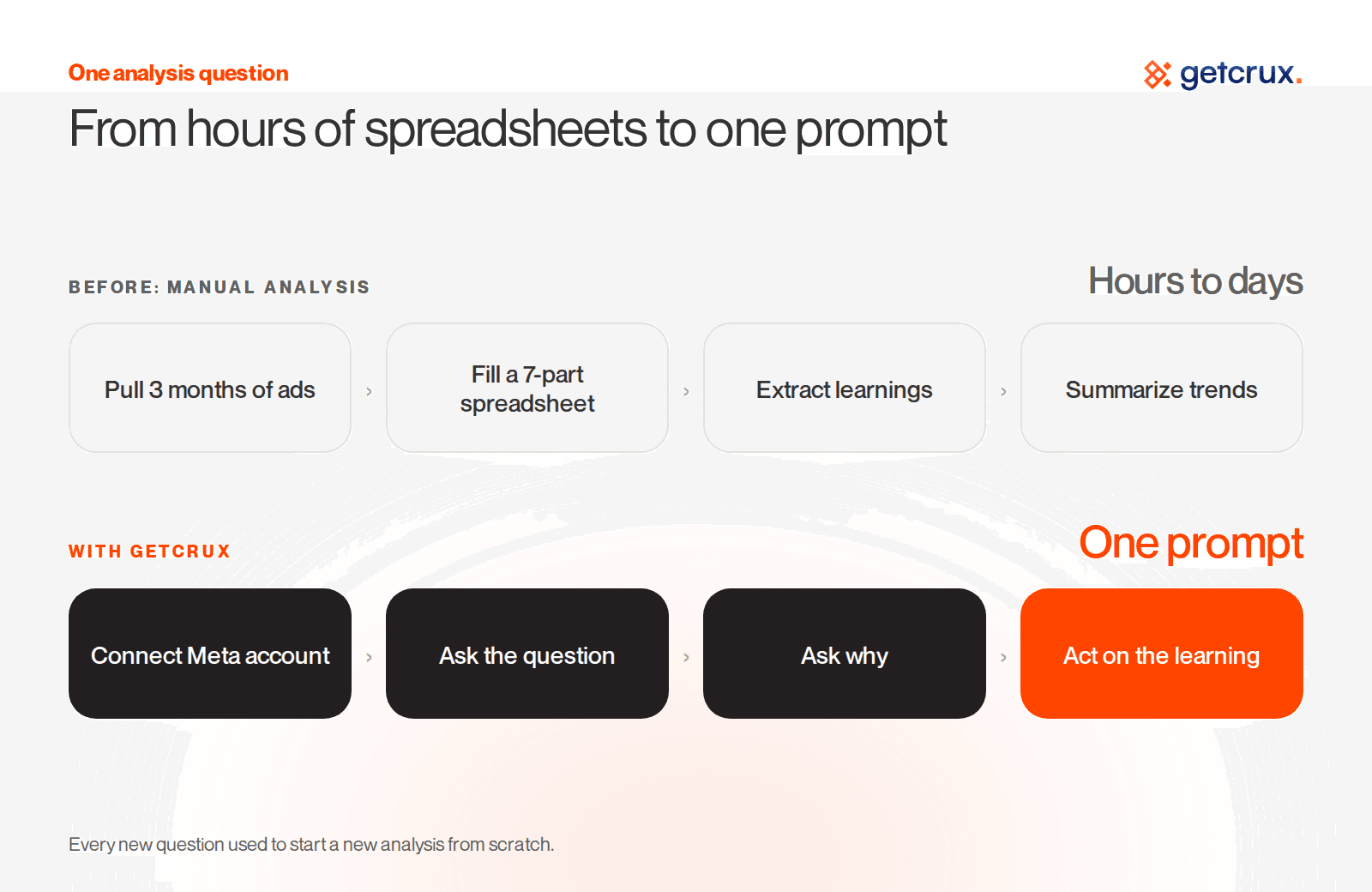
With GetCrux connected to Jerry's Meta account, the team can ask a direct question, such as which videos had the best onboarding CAC. More important, it can then ask why.
"That 'why' piece is what would take us hours or days to do. Being able to ask an AI that knows all your data sped up our learnings so much, because figuring out those key learnings is the whole reason we do analysis."
The platform also lets the team define its own breakdowns. Reports can split every ad in the Meta library by video length, background music, whether a creator appears, the creator's hair color or the headline on a static ad.
6. Unlocking static ads
The second gain came from statics. Jerry was very strong at video. Static ads, which can appear at any point in the customer journey, were an area where the team felt it could do more, although it lacked the graphic design resources.
"There is a really high ceiling for what static could be in our marketing mix. We were really good at video, and we were not exceptional at static."
With GetCrux, the team supplies references, reviews what competitors are running and generates AI static ads grounded in its own performance data. Motion's team used the same approach to generate thousands of image ads with AI.
"At the end of the day, it saved us time. The only thing you cannot get back is time, so anything that saves time holds extreme value to any company that wants to grow."
7. Working with the GetCrux team
Myles points to two qualities. The first is a short learning curve. The dashboards for creating static ads are user-friendly, which he sees as rare among AI tools. The second is flexibility: teams can use GetCrux for a quick overview or build custom reports that answer the questions they could not answer before.
He also values the pace of product updates, since the AI space changes quickly.
"Any company that felt too comfortable in the AI space found a new video generator come out that was way better. So the fact that you are continually building on the product is a really large green flag."
8. The future of AI in creative strategy
Myles expects AI to make winning formats visible to everyone. Tools will scan Meta, social platforms and even connected TV, so trends that brands once kept to themselves will be easy to find.
In that world, the advantage moves back to the customer. Copywriting will still depend on talking to real people, and the brands that win will be the ones that understand their buyers best and test the most concepts.
"AI is going to speed up a lot of things, but that is not to say you should stop focusing on what your customers really want before you use AI."
Key takeaways for growth and creative teams
Start with user interviews. In a hard category, specific pain points make stronger ads than product claims.
Set a primary and a secondary angle before production. Each ad then becomes a clear test.
Sort every ad into red, yellow or green. The bucket decides the next step.
Automate the analysis, keep the judgment. Let AI answer the "what" and the "why", and spend the saved hours on customers and concepts.
Treat statics as a growth channel. AI static ads built on real performance data can close a design resource gap.
Frequently asked questions
How does Jerry analyze its Meta ad creatives?
Jerry connects its Meta ad account to GetCrux and asks questions in plain language, such as which videos produced the best onboarding CAC and why. Before this, each question required hours or days of manual spreadsheet work.
What is the red, yellow and green ad bucket system?
It is a way to sort ads after they run. Red ads underperformed and are left alone. Yellow ads show potential and are improved using elements from green ads. Green ads are top performers that get scaled and iterated on.
What are primary and secondary angles in an ad?
The primary angle is the main reason a product adds value for the customer. The secondary angle is a supporting benefit. Jerry sets both for every ad before production, based on user research.
Can AI tools create finished ad creatives?
Most general AI tools produce useful ideas and drafts, but teams still spend time turning them into on-brand ads. Tools trained on a brand's own ad data, such as GetCrux, shorten that step for static ads.
Want to see what is driving results in your own ad account? Get a free creative scan or book a demo with the GetCrux team. You can also read more GetCrux case studies.